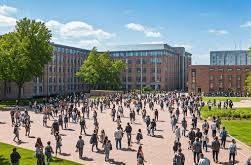
Meeting the minimum requirements is no longer a guarantee of a desk; it is simply the entry fee for a hyper-competitive race. Institutional data shows that application volumes are nearly 20 to 40 times higher than actual capacity.
| University | Total Applications (approx.) | Available First-Year Spots |
| University of Johannesburg (UJ) | 450,000 applicants (870,000 choices) | 11,200 |
| University of the Witwatersrand (Wits) | 160,000 | 5,800 |
| Stellenbosch University (SU) | 106,000 | 6,074 |
| University of Cape Town (UCT) | 102,000 | 4,000 |
| University of Pretoria (UP) | 340,000 (started apps) | 9,700 |
Most Competitive Degrees
The pressure is most intense in Health Sciences, Law, and Engineering. At Stellenbosch University, some programs have odds that seem almost impossible:
- B. Nursing Science: 22,556 applications for 50 places.
- Bachelor of Laws (LLB): 19,137 applications for 120 places.
- Medicine (MBChB): 17,363 applications for 300 places.
- UKZN Nursing: Over 27,000 applications for a limited cohort.
Managing the Influx
To ensure fairness, universities have turned to advanced technology and strict oversight:
- Automation: Wits uses a “rules engine” within their Student Information Management System (SIMS) to filter applicants based on points and specific subjects.
- Digital Expansion: Since infrastructure is capped by Department of Higher Education (DHET) targets, UJ has launched UJ Digital for online degrees, while UCT and Wits are investing in “Smart Classrooms” and blended learning.
- Holistic Evaluation: UCT assesses performance alongside school context and redress factors to ensure a diverse intake.
Advice for the “Turned Away
Universities and experts are urging students to look beyond the “Big Five” traditional institutions. If you haven’t secured a spot, consider these vital alternatives:
- TVET Colleges: Focus on vocational skills that are in high demand in the South African economy.
- Bridging Programs: Programs like SU’s SciMathUS help students improve their results for a second chance.
- Private Institutions: Many accredited private colleges offer degrees with similar curricula but smaller class sizes.
- Gap Year: Use the time for learnerships or improving STEM subjects (Maths and Science) to strengthen future applications.
Note: The “national capacity crunch” is a systemic issue. Experts suggest that long-term relief depends on strengthening the entire education pipeline, especially STEM preparedness at the high school level.
Would you like me to help you find a list of registered TVET colleges or private institutions that might still have open enrollment for 2026?