





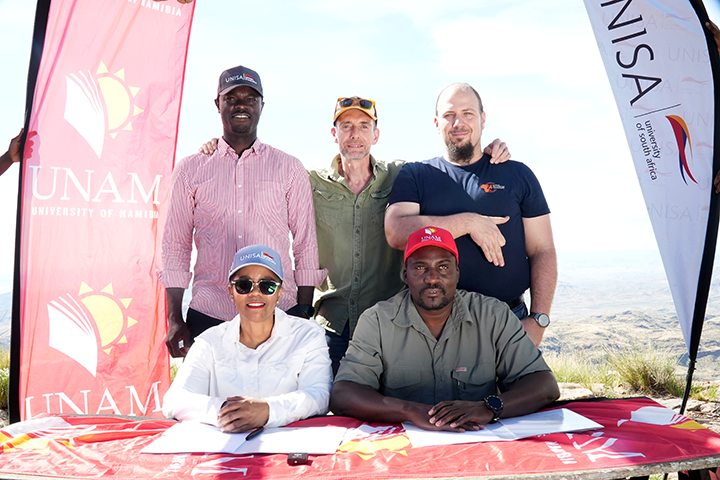
In a massive leap for African science, the University of South Africa (Unisa) and the University of Namibia (UNAM) have solidified a partnership that will place Southern Africa at the heart of global black hole research.
The collaboration focuses on the Africa Millimetre Telescope (AMT)—a next-generation, 14-metre radio telescope to be built on Gamsberg in Namibia’s Khomas Highlands. Once complete, it will be the first of its kind in the region, bridging a critical geographic gap in the global Event Horizon Telescope (EHT) network—the same group that captured the world’s first-ever image of a black hole in 2019.

The “Gamsberg” Advantage: Why Namibia?
Namibia is rapidly becoming one of the most strategically important astronomy sites on Earth. The Gamsberg site was chosen for its:
- Extreme Dryness: Millimetre waves are easily absorbed by water vapor; Namibia’s high-altitude desert air is perfect for “clear” cosmic viewing.
- Zero Interference: Minimal light and radio pollution allow for pristine observations.
- Synergy with H.E.S.S.: The AMT will sit near the High Energy Stereoscopic System (H.E.S.S.), a world-leading gamma-ray observatory. Together, these tools will allow scientists to see both the “light” and the “shadows” of the universe’s most violent phenomena.
Building “Black Hole Movies”
While the original 2019 black hole image was a “still” photo, the addition of the AMT to the global array will provide the resolution needed to create “black hole movies.” This means researchers can track how gas and dust swirl around a black hole in real-time.
“Africa is not simply hosting infrastructure; it is shaping the future of global astrophysics.” — Prof. Marc Klein Wolt, AMT Project Director.
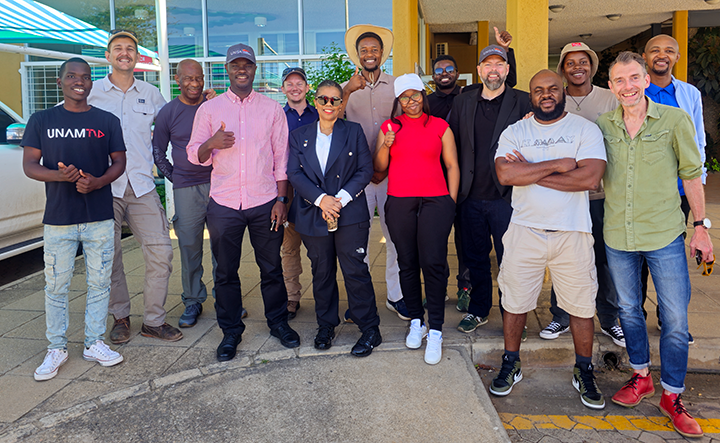
Meet the Next Gen: Africa’s Rising Stars in Space
The project isn’t just about hardware; it’s about a new generation of African researchers who no longer need to go to Europe or the US to do world-class science.
| Researcher | Background | Vision |
| Nhlengani Junior Baloyi (Unisa PhD) | Expert on Active Galactic Nuclei (AGNs). | Wants to inspire children in rural SA to see astronomy as a viable career. |
| Dr. Portia Legodi (Unisa Centre for Astrophysics) | Specializes in high-resolution radio galaxy imaging. | Focused on turning “invisible forces” into bold science that reshapes the cosmos. |
| Hiiko Katjaita (UNAM PhD Candidate) | Preparing for AMT scientific operations. | Believes the “centre of gravity” for global research is shifting to Africa. |
| Dr. Lott Frans (UNAM Postdoc) | First-ever PhD in Astrophysics produced within Namibia. | Aiming for African self-sustainability in STEM through outreach. |
The Leadership Vision
On 24 and 25 February 2026, Unisa Principal and Vice-Chancellor Professor Puleng LenkaBula met with UNAM Vice-Chancellor Professor Kenneth Matengu to sign off on the long-term scientific roadmap.
For Unisa and UNAM, this is more than a telescope—it is a statement of “Infrastructure Sovereignty,” ensuring that African researchers lead the discoveries made on African soil.