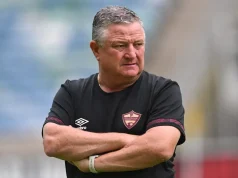








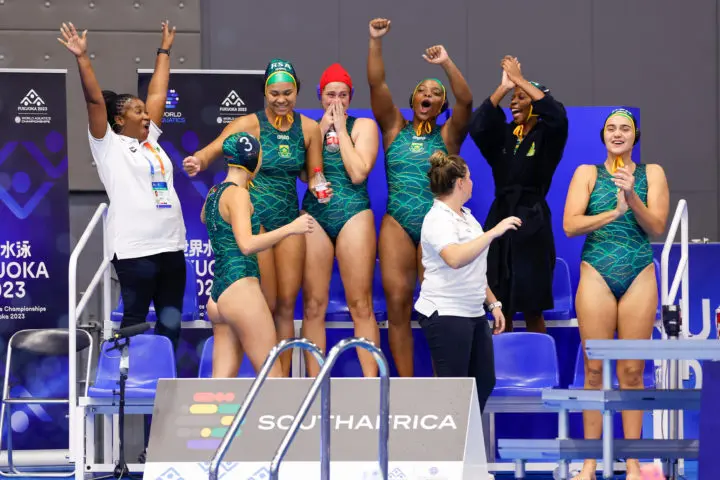
South Africa’s water polo landscape could be heading for a major transformation after Minister of Sport, Arts and Culture Gayton McKenzie publicly pledged his full support to South Africa Water Polo (SAWP), the independent organisation challenging Swimming South Africa’s (SSA) authority over the sport.
Speaking during a media briefing at Parliament on Tuesday, 17 November, McKenzie made it clear that he intends to help SAWP secure official recognition, describing its representatives as patriotic South Africans committed to the development of water polo and the welfare of athletes.
“I support you 100%,” McKenzie declared, according to IOL, promising to assist the organisation in its quest for recognition.
The minister also revealed that he had been advised against supporting the breakaway body but chose to hear its representatives out before making his decision.
His endorsement comes at a particularly turbulent time for South African aquatics, with SSA facing an investigation into its governance, administration and treatment of athletes.
Swimming South Africa faces mounting scrutiny
The minister’s intervention follows the controversy surrounding Olympic champion Tatjana Smith, South Africa’s most decorated Olympian, who recently announced her decision to represent the Netherlands after a prolonged dispute with SSA.
Among the issues was prize money earned at the 2023 World Championships, which was withheld after Smith failed to wear the federation’s sponsor-branded kit.
McKenzie publicly apologised to Smith, saying she had been treated like an enemy of the country, and called for a comprehensive investigation into SSA.
The South African Sports Confederation and Olympic Committee (SASCOC) has been tasked with leading the investigation and deploying a team to help stabilise the federation.
The investigation will examine SSA’s sponsorship agreement with Arena, associated penalties, expenditure at the Franschhoek High Performance Centre and concerns surrounding the federation’s constitution.
SASCOC has committed to providing monthly updates, with preliminary findings expected within 90 days.
McKenzie has, however, acknowledged that government cannot simply remove SSA’s leadership, as direct political interference could expose South Africa to possible international sanctions from World Aquatics.
SAWP steps forward with athlete-first commitment
While the dispute over governance continues, SAWP says its priority is to protect athletes and ensure that South African water polo remains competitive internationally.
Chief executive Robbie Taylor has welcomed the minister’s intervention and offered the organisation’s operational and legal assistance to the Department of Sport, Arts and Culture.
Taylor reiterated SAWP’s willingness to work alongside McKenzie, SASCOC and World Aquatics to ensure athletes are no longer forced to choose between their sporting ambitions, personal integrity and national representation.
In a statement released on 18 November, SAWP reported that it had secured 2,563 registered members across seven provinces. The organisation claims this represents 97.9% of South Africa’s active competitive water polo community, including 1,203 members under the age of 21.
SAWP also says submissions made by members of the water polo community to the Aquatics Integrity Unit earlier this year contributed to the provisional suspensions of SSA’s senior executives.
Financial support has also become a key part of its efforts.
The organisation reports having raised R910,000 through corporate partners and donors to assist national teams with preparation, travel, accommodation and playing kit. It is also introducing a crowdfunding platform to help ease the financial burden on players.
According to IOL, the cost per player for upcoming international tours has been reduced to R5,000.
Importantly, SAWP says this assistance will be available to all national team players, regardless of whether they are registered members of the organisation.
World Aquatics holds the key to official recognition
Despite McKenzie’s public endorsement, SAWP’s international recognition remains unresolved.
Swimming South Africa continues to hold the country’s membership of World Aquatics, whose constitution generally permits only one recognised member federation per country.
In October, SAWP submitted an application under Article 5.5 of the World Aquatics constitution, seeking authority to administer water polo in South Africa during a transitional period. SSA is reportedly contesting the application.
A significant development followed later that month when World Aquatics appointed a Stabilisation Committee, chaired by Felipe Perrone, to oversee South Africa’s preparations and selection process for the upcoming World Cup. SAWP has been entrusted with operational responsibilities.
The immediate international focus is now on the national teams.
South Africa’s women’s team is scheduled to compete in the World Cup Division 2 tournament in Coimbra, Portugal, from 7–13 December 2026, where they will face China and Germany in Group B.
The men’s team will take part in the Division 2 competition in Istanbul, Türkiye, from 18–24 January 2027.
A defining moment for South African water polo
McKenzie’s backing represents an important political development for SAWP, but the organisation still faces the challenge of securing formal recognition from World Aquatics.
With SSA under investigation, athletes and administrators demanding accountability, and international competitions approaching, the coming months could prove decisive for the future direction of South African water polo.
At the heart of the dispute is a fundamental question: who should govern the sport, and how can South Africa build a system that genuinely puts its athletes first?
For now, SAWP has secured the minister’s public support. Whether that translates into lasting institutional recognition remains the next major test.