








By Jimmy Zwane
Published: October 17, 2025, 6:30 a.m. KST
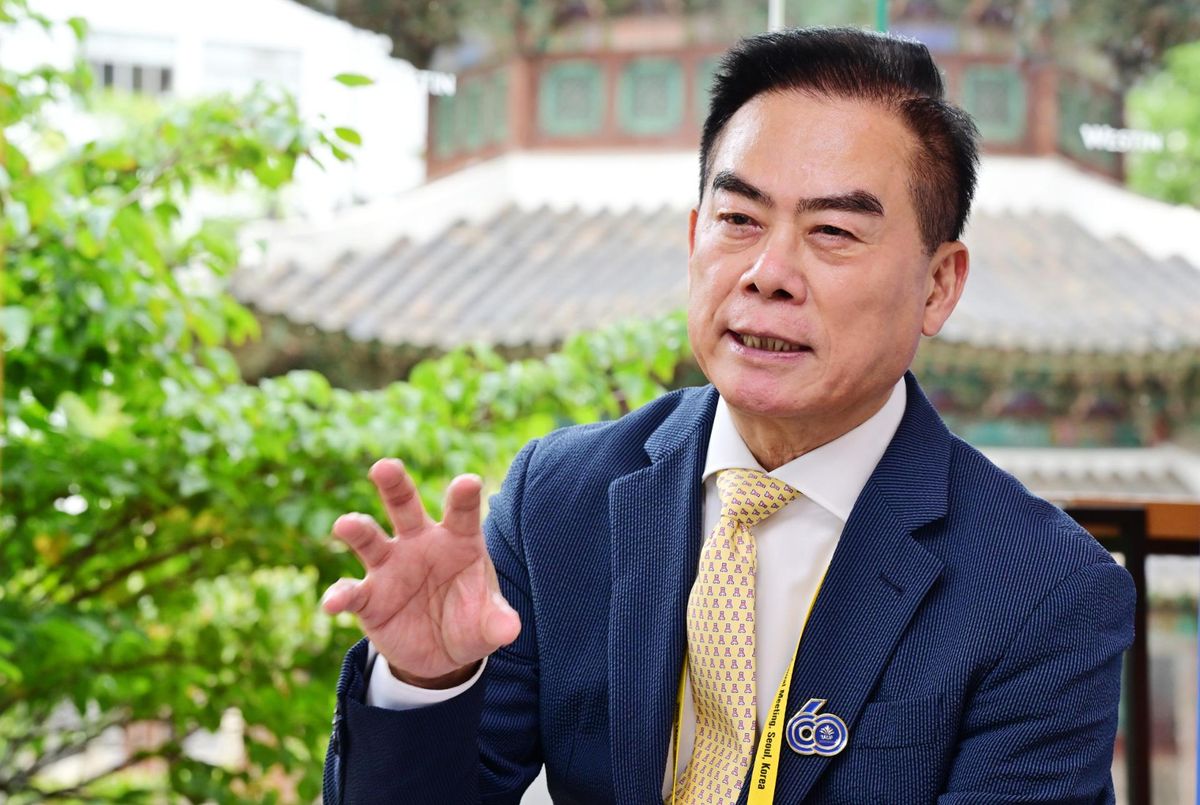
“Change is no longer optional.” That was the core message from Shawn Chen, President of the International Association of University Presidents (IAUP), as he urged higher education institutions across the globe to respond swiftly and seriously to the transformative rise of artificial intelligence (AI).
Speaking during an interview with The Korea Times at The Westin Josun hotel in Seoul, Chen emphasized that universities are falling behind in a world where technology—particularly AI—is advancing at an unprecedented pace.
Chen, who is also the founder of China’s Sias University, was in South Korea to celebrate the IAUP’s 60th anniversary. However, amid the festivities, his message to the academic world was clear: AI is redefining the landscape of education, and institutions must evolve—or risk becoming obsolete.
“Education used to help people stay ahead of their time. Now, it’s lagging behind industry,” said Chen.
He noted that while industries have been quick to innovate and integrate emerging technologies, education remains one of the most resistant sectors to change.
“If you can call education an enterprise or industry, it is the largest one. The U.S. has about 4,000 universities, and China has 3,400. For each country, universities or higher education is the largest industry. So, it is hard to change,” he said.
Despite this inertia, Chen warned that institutions can no longer afford to ignore AI’s growing influence.
“Whether they welcome it or not, it is already here with us. You cannot stop the inevitable, like raining or snowing,” he said.
According to Chen, students are already ahead of the curve. They are using AI tools like ChatGPT and Gemini in their learning—even before many educators are familiar with them.
“Some teachers or schools don’t want students using ChatGPT or Gemini because they worry about cheating,” he said.
“But it’s not cheating anymore. We live in a different time. Farmers used to work with their bare hands until they adopted tractors. Now, it’s time for education to adopt its own ‘tractors.’”
Chen argued that rather than restricting the use of AI, universities should guide students on how to use these tools effectively and ethically. He emphasized the need to redesign curricula to integrate AI directly into education models.
“We are leading efforts to redesign curricula through ‘AI + X and Y’ educational models. The ‘X’ represents each student’s major, while the ‘Y’ refers to a micromajor that supports their future career path,” Chen explained.
He pointed to trends in countries like Japan, which has adopted a five-year program that combines undergraduate and postgraduate studies, reflecting a broader shift toward longer, more comprehensive education in the AI age.
“Due to the emergence of AI, everybody now needs to study beyond a bachelor’s degree. A master’s is becoming the new standard,” Chen added.
While some fear that AI could render traditional higher education obsolete, Chen disagreed. He believes AI is a tool—not a replacement for human learning, ethics, and creativity.
“Everyone has a smartphone, and smartphones can answer anything. But a smartphone is just a smartphone,” he said.
“It may be another head or brain to us. It can help us become much smarter. Our role is to teach students how to use this ‘second brain’ to achieve their goals.”
He further stressed that there are aspects of human experience that AI will never replicate.
“Some people fear we won’t need universities anymore because AI can do everything better. But it cannot replace everything—such as moral systems, the arts, and our delicate human nature,” Chen said.
Before becoming president of IAUP, Chen was widely recognized for his contributions to international education. He has received awards from multiple institutions and governments, including:
- The Provincial Government of Henan and Zhengzhou Municipal Government in China
- The Kansas State Government and its Governor
- The Los Angeles City Government and its Mayor
As the IAUP enters its seventh decade, Chen’s message is both a challenge and a call to action: embrace the emergence of AI not as a threat, but as an opportunity to reimagine what education can and must be in the 21st century.