









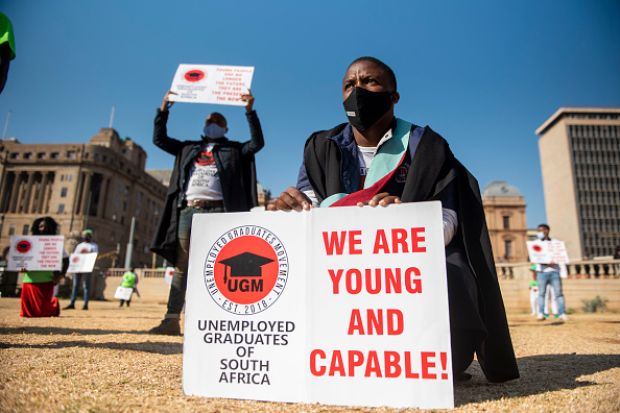
As graduation season sweeps across South Africa, over 220,000 graduates are entering the workforce annually. Yet behind the celebratory photographs lies a harsh economic reality: graduate unemployment shot up to 12.2% in the first quarter of 2026, with the unemployment rate among graduates under 35 hovering near a staggering 24%.
While policymakers frequently blame a “skills mismatch,” the truth is far more complex. Higher education institutions cannot fix a stagnant economy on their own. Solving this systemic crisis requires an aggressive, synchronized strategy from universities, the government, and the private sector.
The Limits of Curriculum Reform
There is no doubt that tertiary education must evolve, especially as Artificial Intelligence threatens to automate up to 20% of South African work activities by 2030. Currently, only one-sixth of the population possesses advanced digital skills. To bridge this gap, universities must:
- Embed Work-Integrated Learning: Move internships and practical placements from a final-year afterthought to a first-year requirement.
- Prioritize Digital & AI Literacy: Modernize outdated qualification frameworks to keep pace with rapid technological shifts.
- Cultivate Entrepreneurship: Shift the focus from training job seekers to nurturing job creators.
However, structural bottlenecks remain. Out of more than 560,000 students enrolled in Technical and Vocational Education and Training (TVET) colleges recently, only just over 18,000 successfully secured workplace placements. The pipeline is leaking at every joint.
The Real Culprit: A Sluggish Labour Market
Data from the research forum Econ3x3 reveals that the spike in graduate unemployment over the past decade is predominantly linked to a sluggish labor market, not student performance or degree choices. Pumping hundreds of thousands of qualified citizens into an economy incapable of absorbing them is no longer a success metric—it is a pressure gauge.
As Prof. Linda du Plessis, Senior Deputy Vice-Chancellor at North-West University, noted:
“Higher education must adapt curricula for employability, but it cannot resolve the labour market mismatch alone. This challenge necessitates systemic coordination between education, industry and government.”
A Call to Action for Government and Corporate SA
To turn the tide, the burden of job creation must be shared equitably:
- Government: The Department of Higher Education, Science, and Technology must align with industrial sectors to draft policies that stimulate formal-sector graduate employment.
- Employers: Corporate South Africa must move away from the paradox of demanding “experienced” entry-level candidates while refusing to fund the entry-level infrastructure.
- Scale Successful Frameworks: Programs like the Youth Employment Service (YES)—which has placed over 228,000 youth into high-growth sectors like digital ICT and the green economy since 2018—prove that structured pipelines work. Corporate participation in these initiatives must become an industry-wide norm, rather than a tokenistic exercise to secure B-BBEE compliance certificates.
Ultimately, graduate unemployment is not merely an educational hurdle or a labor statistic. It is a profound social justice issue. Behind every percentage point is a thwarted human life, demanding a unified national response.