


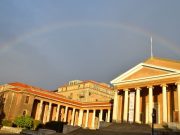







South Africa has once again secured a place on the global higher-education map, with three universities ranked among the world’s top 500 in the 2026 Academic Ranking of World Universities (ARWU).
The University of Cape Town (UCT) emerged as South Africa’s highest-ranked institution, followed by the University of the Witwatersrand (Wits) and Stellenbosch University.
The ARWU, commonly known as the Shanghai Ranking, evaluates universities primarily on research performance, academic achievements and the quality of their research output.
Unlike some university rankings that place greater emphasis on surveys and reputation, ARWU relies heavily on objective indicators such as research publications, citations, highly cited researchers and major academic awards.
UCT remains South Africa’s top-ranked university
UCT was placed in the 201-300 global range, making it the highest-ranked South African university in the 2026 rankings.
The Cape Town institution was also the only South African university to feature in the 201-300 band.
Its strong performance was driven largely by research output, including its publication record and the impact of its highly cited academic work, particularly in scientific disciplines.
UCT’s position reinforces its reputation as one of Africa’s leading research universities.
Wits and Stellenbosch complete South Africa’s top three
The University of the Witwatersrand was ranked in the 301-400 range, placing it second nationally.
Stellenbosch University followed in the 401-500 range, making it the third South African institution to break into the global top 500.
The rankings therefore give South Africa three representatives among the world’s 500 highest-ranked universities.
South African universities in the ARWU top 1,000
Several other South African institutions also featured in the global top 1,000.
| South African rank | University | 2026 global range |
|---|---|---|
| 1 | University of Cape Town | 201-300 |
| 2 | University of the Witwatersrand | 301-400 |
| 3 | Stellenbosch University | 401-500 |
| 4 | University of Pretoria | 501-600 |
| 5-6 | University of Johannesburg | 601-700 |
| 5-6 | University of KwaZulu-Natal | 601-700 |
| 7-8 | North-West University | 801-900 |
| 7-8 | University of South Africa | 801-900 |
Universities are grouped into bands after the top 100 rather than being given individual positions. Institutions within each band are listed alphabetically.
What does the ARWU measure?
The Academic Ranking of World Universities places considerable emphasis on research excellence and academic achievement.
Its methodology uses six key indicators:
- Nobel Prizes and Fields Medals won by alumni – 10%
- Nobel Prizes and Fields Medals won by staff – 20%
- Highly cited researchers – 20%
- Papers published in Nature and Science – 20%
- Papers indexed in major international citation databases – 20%
- Per-capita academic performance – 10%
This means universities with strong research programmes and internationally recognised academics tend to perform particularly well.
Harvard retains global number one spot
At the top of the global table, Harvard University retained the number-one position.
The US institution has occupied the top spot in the ARWU rankings since 2003.
Stanford University ranked second, followed by MIT in third.
The University of Cambridge was fourth, while the University of California, Berkeley rounded out the top five.
The remainder of the global top 10 included Princeton, Oxford, Columbia, the University of Chicago and Caltech.
Top 10 universities globally
| Rank | University |
|---|---|
| 1 | Harvard University |
| 2 | Stanford University |
| 3 | Massachusetts Institute of Technology |
| 4 | University of Cambridge |
| 5 | University of California, Berkeley |
| 6 | Princeton University |
| 7 | University of Oxford |
| 8 | Columbia University |
| 9 | University of Chicago |
| 10 | California Institute of Technology |
South Africa’s showing
While no South African university reached the global top 100, the presence of UCT, Wits and Stellenbosch in the top 500 highlights the country’s continued strength in research-led higher education.
UCT’s position at the top of the South African table will also add to its strong standing in international university rankings.
For students, academics and policymakers, the latest results provide another snapshot of how South Africa’s leading universities compare with institutions around the world.