



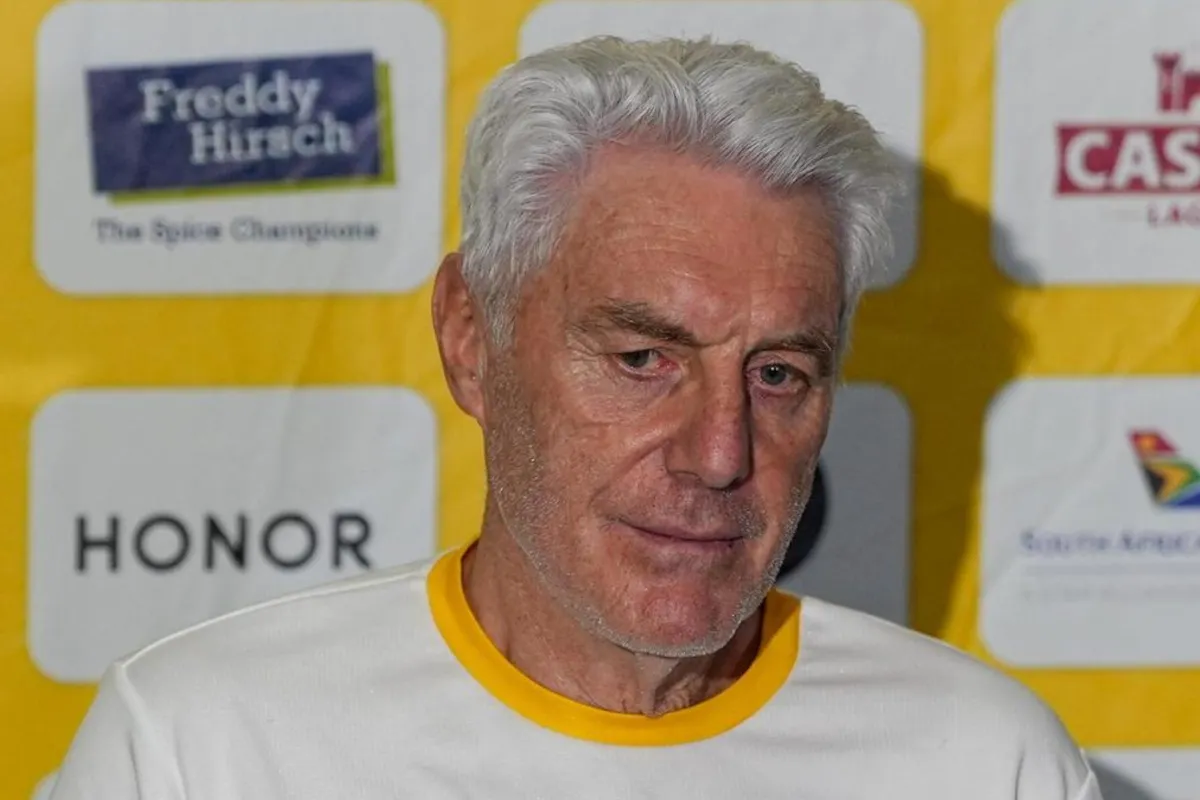
Former Bafana Bafana coach Hugo Broos has admitted that he continues to regret the controversial comment he made about young defender Mbekezeli Mbokazi, acknowledging that his choice of words was inappropriate.
Almost a year after the incident, the Belgian coach says the remarks still weigh on his mind, even though he insists they were never intended to carry a racist meaning.
The controversy erupted in December when Mbokazi arrived late to the Bafana Bafana training camp ahead of the Africa Cup of Nations in Morocco. Broos was visibly frustrated by the player’s absence and told journalists that he intended to confront him after training.
During the media briefing, he made a remark that attracted widespread criticism.
“I will have a chat with him after training and I can assure you, he’s a black guy now but he will leave my room as a white guy,” Broos said at the time.
The comment was interpreted by many as suggesting that white people were more responsible than black people. It sparked a public backlash, with political parties and lobby groups lodging complaints with the South African Human Rights Commission over alleged racism.
Broos subsequently issued a public apology, explaining that he had not intended to make a racial statement. He said his frustration came from concern about Mbokazi’s behaviour and the possibility of the young defender failing to fulfil his potential.
Speaking on Prime Sports With Mahlatse this week, Broos reflected on the incident and admitted that he wished he had expressed himself differently.
“I still regret what I said when they said it was racist what I said about Mbokazi,” he said.
The former coach maintained that his intention was to warn the defender about the seriousness of his actions, rather than make a racial comparison.
“But everybody knew that I didn’t mean that. I just wanted to tell him look, he will be pale, he will be afraid of what I’m going to tell him,” Broos explained.
He also acknowledged that English, which is not his first language, contributed to the way he expressed himself.
“But English is not my language and then you try to translate here (in the mind) but here you have to tell. And yeah, the words were not the right words what I said. But the meaning of it is what I wanted.”
Despite accepting that his wording was wrong, Broos maintained that Mbokazi’s late arrival at camp was unacceptable, particularly given the importance of preparing for a major international tournament.
“But it was not good what Mbokazi did. How can you miss your flight when you have to go to the preparation of the World Cup?” he said.
Broos also spoke about the pressures facing young footballers who suddenly find themselves in the national spotlight. He pointed to Mbokazi’s rise and the attention surrounding Relebohile Mofokeng as examples of why emerging talents need proper guidance.
According to the Belgian, he was concerned that the attention surrounding young players could influence their decisions, making it important for them to have people around them who genuinely wanted the best for their careers.
He recalled that his frustration grew when a journalist questioned him about Mbokazi’s absence during the media briefing.
“You are 19, 20, everybody likes you and for me it was that moment that he didn’t come for the first day for preparation. I was so angry, but I wouldn’t say anything,” Broos said.
However, when asked what he intended to do about the defender, he admitted that his emotions took over and he made the controversial statement.
Looking back, Broos did not attempt to defend his choice of words.
“It was stupid. I know it was stupid. I didn’t have to say it like that,” he concluded.
His latest comments show that the incident remains a source of regret for the Belgian, who continues to acknowledge that his message should have been delivered in a different way.