








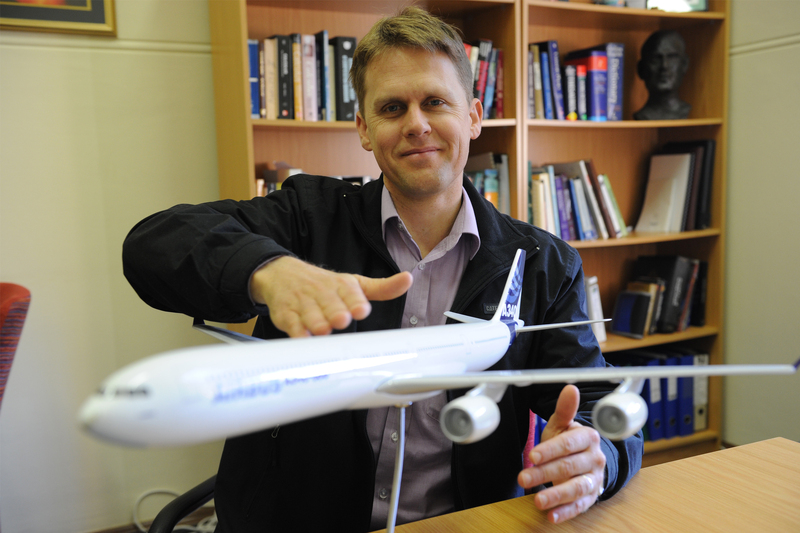
In a landmark moment for South African science, Professor Arnaud Malan and his team from the University of Cape Town (UCT) recently presented a “game-changing” aerospace breakthrough to 12 of the world’s leading experts at the NASA Glenn Research Center.
The focus? Liquid Hydrogen (LH2)—the lightweight, carbon-free fuel hailed as the future of flight, but notorious for being a nightmare to store and control. Thanks to UCT’s new AlphaFlow software, engineers can now model these ultra-cold cryogenic tanks up to 40 times faster than current global standards.
The Innovation: Why “AlphaFlow” is a Giant Leap
Storing liquid hydrogen involves a violent “war” of physics inside a tank—evaporation, condensation, and extreme turbulence all fighting for dominance. Traditional computer models are often too slow or too inaccurate to keep up.
How the UCT team solved it:
- The “Paradigm Shift”: Instead of letting equations “fight” each other, the team reformulated the math. They created a framework that predicts how the system will behave before the simulation even starts.
- Near Real-Time Computing: In one test, AlphaFlow modeled 423 seconds of complex tank behavior in just 14 minutes. To put that in perspective, established commercial tools are dozens of times slower.
- Machine Precision: Most software suffers from “numerical drift” over millions of time steps. Prof. Malan’s team enforced mass and energy conservation to such a high degree that errors don’t accumulate, even in long-duration simulations.
- The Power of the Pen: While most tech relies on faster hardware (GPUs), Malan famously told NASA, “The pen is mightier than the sword.” His team focused on smarter governing equations rather than just raw processing power.
A Global Collaboration
The seminar was organized by Professor Mohammad Kassemi, Director of the National Center for Space Exploration Research. NASA researchers, who have led this field for decades, expressed high praise for the South African team’s numerical efficiency.
“All of us are intrigued by the numerical efficiency… We hope that we can learn from what you have done,” noted a NASA participant.
AlphaFlow is the result of a public-private partnership between Prof. Malan’s SARChI Chair and the UCT spin-off company Elemental Numerics, supported by the DSI-NRF and the European Union.