







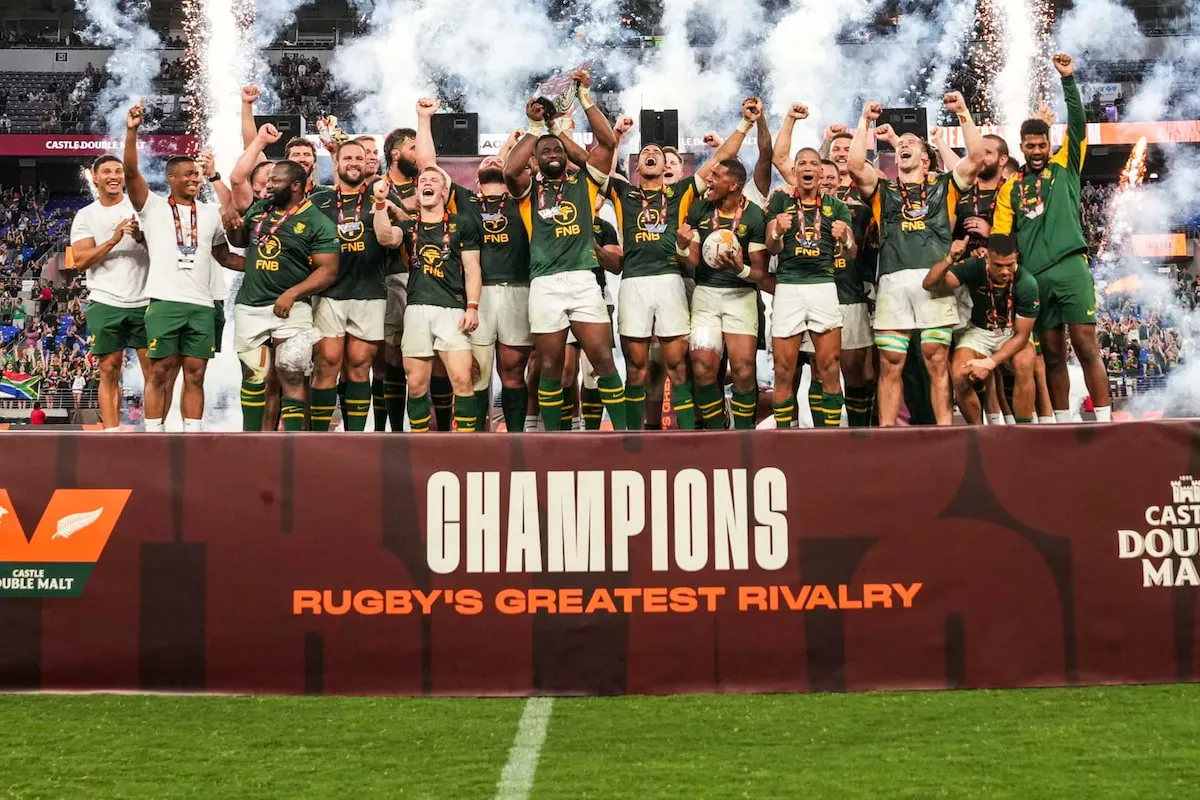
The Springboks’ historic 3-1 series victory over the All Blacks delivered plenty of sporting value — but the Rugby’s Greatest Rivalry also appears to have provided a significant financial boost for SA Rugby.
The recently concluded four-Test series was played across South Africa and the United States, with packed stadiums and a groundbreaking final encounter in Baltimore contributing to substantial reported revenues.
While the precise amount ultimately received by South African Rugby remains subject to the final commercial accounting, available reports suggest SA Rugby could have benefited by between R170 million and R200 million from the series.
Three South African Tests generated major revenue
The first three matches of the series were staged in South Africa, with Ellis Park, Cape Town Stadium and FNB Stadium hosting the Springboks and All Blacks.
All three venues attracted large crowds, creating significant matchday income through ticket sales, hospitality, merchandise, broadcasting and concessions.
Reports have estimated that each of those Tests generated between R60 million and R80 million in earnings.
Even using the lower end of those estimates, the three matches collectively generated approximately R180 million in revenue.
However, the total amount generated by a match is not the same as the amount retained by either rugby union, meaning the eventual payout to SA Rugby would depend on the commercial arrangements surrounding each fixture.
Baltimore Test delivered another financial boost
The fourth and final Test took the rivalry into new territory when the Springboks and All Blacks met at M&T Bank Stadium in Baltimore.
The match was reportedly estimated to have generated around $8 million, equivalent to approximately R129 million-R130 million at the exchange rate cited in reports.
The fixture was particularly significant because it formed part of World Rugby’s broader strategy to grow the sport in the United States ahead of the 2031 Rugby World Cup, which will be hosted in America.
The revenue-sharing agreement reportedly saw the two unions split income from areas including tickets, hospitality, merchandise, broadcasting and matchday concessions.
Under the reported 50-50 arrangement, each union would have received approximately $4 million, or around R64.5 million, from those revenue streams.
Additional World Rugby support and commercial arrangements could have increased the overall value of the Baltimore fixture.
SA Rugby’s reported series payout
Taking the first three South African Tests and the Baltimore encounter into account, reports have suggested that SA Rugby could have earned somewhere in the region of R170 million to R200 million from the overall Rugby’s Greatest Rivalry campaign.
The exact figure is difficult to establish because different reports appear to use different definitions of “earnings”.
Some estimates for the Baltimore match, for example, have placed the amount received by each union between R84 million and R90 million.
Those higher figures reportedly include additional commercial elements such as sponsorship activations, broadcasting arrangements and World Rugby support for logistics.
That means the reported R170 million-R200 million range should be viewed as an estimate rather than a confirmed SA Rugby financial statement.
Why Baltimore made commercial sense
For SA Rugby, the decision to take the final Test to the United States was about more than simply staging a match in a new market.
The organisation has identified international expansion and reaching new audiences as important strategic objectives.
SA Rugby CEO Rian Oberholzer acknowledged that the Baltimore fixture had to make substantial commercial sense.
“We wouldn’t be doing it if it wasn’t substantial,” Oberholzer said, according to reporting by The New York Times.
He also highlighted the opportunity to introduce the Springboks to new audiences and territories.
The fact that the match featured South Africa and New Zealand — two of rugby’s biggest international names — provided an opportunity to promote the sport in one of the world’s largest commercial markets.
A win on and off the field?
The Springboks ultimately claimed the series 3-1, making the Rugby’s Greatest Rivalry a significant sporting achievement for South Africa.
At the same time, the series generated considerable commercial interest across its four matches.
For SA Rugby, the reported financial returns come at an important time as the organisation continues to manage the demands of international rugby while preparing for future global competitions.
The Baltimore Test also demonstrated the potential commercial value of taking high-profile Springbok fixtures beyond traditional rugby markets.
With the 2031 Rugby World Cup heading to the United States and the 2027 tournament taking place in Australia, international expansion is likely to remain an important part of rugby’s long-term commercial strategy.
For now, the headline figure is striking: based on reported estimates, SA Rugby could have benefited by roughly R170 million to R200 million from the four-Test Rugby’s Greatest Rivalry series.
The exact final figure, however, will depend on the commercial accounting and which revenue streams are ultimately included.